
India's annual oil import bill could rise by $9-11 billion if the country is compelled to move away from Russian crude in response to US threats of additional tariffs or penalties on Indian exports, analysts said. India, the world's third-largest oil consumer and importer, has reaped significant benefits by swiftly substituting market-priced oil with discounted Russian crude following Western sanctions on Moscow after its invasion of Ukraine in February 2022.

Foreign brokerages remain cautious on the road ahead for the Indian equity markets. Though analysts at Nomura have revised their March 2026 Nifty target to 26,140 levels from the earlier 24,970, but the upside from the current levels is a modest 6 per cent. BofA Securities, on the other hand, has not made any change to its year-end Nifty target.

'It was like rigorously preparing for a solid, good exam...' 'I don't know what marks I will get, but I felt the rigorous preparation of an exam.' 'You may sweat, but I feel rejuvenated.'

International Master Atanu Lahiri, a former joint secretary, AICF, in a complaint to the Registrar of Societies, Tamil Nadu has urged the initiation of a probe on alleged mismanagement or misuse of AICF funds and even dissolve the chess body if gross violation of its objectives and obligations were found.
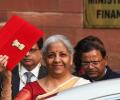
'... that it once again shies away from renewing its commitment to strategic divestment,' points out A K Bhattacharya.

India's economic growth forecast for 2025 has been revised downward to 6.3 per cent, and despite a projected moderation, the country remains one of the fastest-growing large economies, supported by resilient consumption and government spending, the United Nations has said.

Wholesale price inflation dropped to 0.85 per cent in April as prices of food articles, manufactured products, and fuel eased, government data showed on Wednesday. WPI-based inflation was 2.05 per cent in March. It was 1.19 per cent in April last year.

India will oppose the World Bank funding to Pakistan next month, arguing that Islamabad has used such funds in the past to procure arms and ammunitions. India previously lobbied against the IMF extending a USD 2.3 billion assistance to Pakistan earlier this month, presenting evidence of Pakistan's misuse of funds for military purposes. India feels that Pakistan has failed to act on terror emanating from its territory and has been diverting funds from multilateral agencies to buy arms and ammunition.

The meltdown in Dalal Street that wiped out investor wealth to the tune of 44 trillion in 2025 also seems to be having a ripple effect on the country's vibrant automobile retail sales.

The Union health ministry has been allocated Rs 99,858.56 crore in the Budget 2025-2026, an around 11 per cent hike over the Rs 89,974.12 crore in the budget (revised estimates) of 2024-2025 with the government announcing setting up daycare cancer centres at all district hospitals over the next three years.

Fitch Ratings on Tuesday raised India's growth forecast for the current fiscal to 7.2 per cent, from 7 per cent projected in March, saying elevated consumer confidence will drive spending, besides increased investments. In June update to its global economic outlook report, Fitch said it expects inflation to decline to 4.5 per cent by end of this year and RBI to cut policy interest rates by 25 basis points to 6.25 per cent.

S&P Global Ratings on Friday said it will watch the fiscal numbers for the next 1-2 years, besides pro-growth policies of the new government, before deciding on India's sovereign rating upgrade. S&P, which earlier this week upgraded India's outlook to positive while retaining the sovereign rating at BBB-, expects the new government to continue with pro-growth policies, infrastructure investment and commitment to fiscal consolidation.

Finance Minister (FM) Nirmala Sitharaman has presented a forward-looking Budget, reinforcing the government's commitment to 'Reform, Perform, and Transform'.

'It has also outlived its initial purpose of reducing physical gold imports.'

"The new structure will substantially reduce taxes on the middle class and leave more money in their hands, boosting household consumption, savings and investment," Sitharaman said presenting what was dubbed as 'reformist' budget for the next fiscal in Lok Sabha.

'The first and most basic responsibility of any government is to protect its people from external threats and internal harm.' 'Budget 2025-2026 has to focus on meeting this responsibility,' asserts R Jagannathan.

The time is ideal for a 'Dream Budget' akin to the 1991 reforms that sparked high growth and unlocked significant gains in productivity, points out Rajeswari Sengupta.

The sweeping tariffs proposed across sectors by US President Donald Trump are scheduled to be imposed starting April 2, with most analysts worried about their impact on companies, and in turn the financial markets. Recently, the US administration signaled that it will impose sectoral tariffs on energy, pharmaceuticals, semiconductors, agriculture, copper, and lumber.

'The finance minister missed yet another opportunity to simplify the income tax structure in the Budget.' 'This was an opportune moment to get rid of the old tax system entirely and move fully to the new system,' asserts M Govinda Rao, member of the 14th Finance Commission.

'Each state is unique, but when it comes to finance, the fundamentals cannot be different.'

'The bull market cycle ran for five years. It's the end of that cycle.' 'The next cycle is a down cycle, and in that down cycle, you will see the Sensex falling from their highs of around 68,000 to maybe 40,000-50,000 at the bottom of the cycle.'

It will be the second Budget of the Modi 3.0 government and eighth straight Budget for Nirmala Sitharaman, rare in Indian polity.

'The scrapping of import duty would help Indian companies compete in international markets, thus paving the way for India becoming a space manufacturing hub for the world.'

From FY20 to FY24, the revenue forgone due to tax incentives for individuals and Hindu undivided families stood at Rs 8.7 trillion, significantly higher than the Rs 4.53 trillion forgone for corporations.

Domestic steel prices have seen an increase over the past couple of months in anticipation of a safeguard duty, but a looming global trade war is likely to weigh as threat of import rises and prospect of export flounders. Data from BigMint showed that in March 2025, hot rolled coil (HRC) prices ex-Mumbai increased by Rs 600 per tonne month-on-month (M-o-M), rising from Rs 48,400 per tonne in February to Rs 49,000 per tonne.

Earlier in the day, an IndiGo A320 passenger aircraft landed successfully at 1.32 pm at runway 08/26 of the under-construction Navi Mumbai International Airport, paving the way for the Navi Mumbai International Airport Ltd (NMIAL) to seek an aerodrome licence from the aviation safety regulator Directorate General of Civil Aviation (DGCA) to start commercial flight services.

... catch up with Blinkit, Swiggy Instamart and Zepto...

The Centre could better its fiscal deficit at 6.6 per cent of GDP in this financial year on stronger-than-expected revenue buoyancy, even if the budgeted disinvestment target is not met, Fitch Ratings has said. The international rating agency had last week kept the sovereign rating unchanged at 'BBB-' with a negative outlook, and said that the risks to India's medium-term growth outlook are narrowing with rapid economic recovery from the pandemic and easing financial sector pressures. In an email interview with PTI, Fitch Ratings Director (Asia-Pacific Sovereigns) Jeremy Zook said the two key positive triggers that could lead to a revision of the outlook to stable are implementation of a credible medium-term fiscal strategy to lower debt burden and higher medium-term investment and growth rates without the creation of macroeconomic imbalances, such as from successful structural reform implementation and a healthier financial sector.

Few finance ministers announce any taxation measure that could upset the stock market. Ms Sitharaman decided to take that risk, observes A K Bhattacharya.

With its age-old fascination for education, southern states have done better than the North. Start-ups, IT hubs, and industry majors setting up shop have changed the face of the South. Nearly 79% of global offices set up by international conglomerates in India are in the South. Almost 46% of tech unicorns are from the South. The GDP per person in the South is 4.2 times higher than the North. None of these indicators can be ignored by any central government, whatever the political compulsions, notes Ramesh Menon.
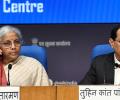
'Our attempt to honour the taxpayer has been since 2014 and more actively since 2019-2020 onwards.'

The fresh meat and seafood delivery startup Licious plans to set up 500 stores nationwide within the next five years as part of an omnichannel strategy. The aim is to attract new users in the offline channel and encourage them to transact online as well. The move would also help the company in its efforts to achieve profitability and go for an initial public offering (IPO) in the next 24 months, according to the sources.

With the fiscal deficit target staring at the government, the FY25 Budget has limited expenditure options, points out A K Bhattacharya.
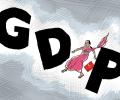
S&P Global Ratings on Monday kept its forecast for India's economic growth unchanged at 6 per cent in the fiscal year starting April 1, before rising to 6.9 per cent in the following year. In the quarterly economic update for Asia-Pacific, S&P saw inflation rate easing to 5 per cent in 2023-24 fiscal, from 6.8 per cent in the current financial year. It saw India's gross domestic product (GDP) likely growing by 7 per cent in the current financial year ending March 31 (2022-23), before slowing to 6 per cent in the next 2023-24 fiscal.

'Nearly 10 million people will benefit from the increase in the rebate limit for those earning up to Rs 12 lakh.' 'We expect all that money will come back into the economy in either savings, consumption, or investments.'

Indian economy is in a sweet spot, with a mix of solid growth and moderating inflation, Moody's Ratings said, forecasting a 7.2 per cent GDP growth in the 2024 calendar year and 6.6 per cent in the next. In its Global Macro Outlook 2025-26, the rating agency said the global economy has shown remarkable resilience in bouncing back from supply chain disruptions during the pandemic, an energy and food crisis after the Russia-Ukraine war began, high inflation and consequent monetary policy tightening.

Now that the economy is growing at a higher-than-expected rate, it is time to accelerate the pace of fiscal consolidation, and the Budget could be a good starting point, argues Rajesh Kumar.

If the fiscal deficit target of 4.9% of GDP has to be met for 2024-2025, which the government must in view of the uncertainties and challenges emerging both domestically and globally, the finance ministry may see in the composition of the current year's capex a sliver of hope, notes A K Bhattacharya.

State-owned Oil and Natural Gas Corporation (ONGC) expects a USD 10.3 billion revenue boost from increased oil and gas production, achieved through a partnership with UK's BP in the Mumbai High field.

The finance minister, in her Budget speech, should focus more on what she is directly responsible for, rather than on programmes where her role is largely supportive, notes Nitin Desai.
